

|
||
|
|
||
|
||
|
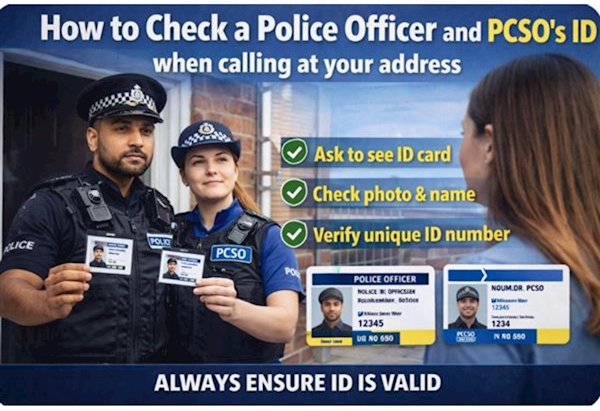
How to check officers ID |
||
|
Afternoon Resident
if a police officer or Police Community Support Officer (PCSO) calls at your address, you should follow these verification steps provided by West Midlands Police and official Police.uk guidance: 1. Request a Warrant Card Every genuine officer, whether in uniform or plain clothes, carries a police warrant card. Visual Check: This is a credit-card-sized ID containing their photograph, name, rank, and the force logo. PCSOs: PCSOs also carry an official identity card that clearly states their role as a "Police Community Support Officer". Doorstep Safety: You are entitled to ask them to show the card through a window or letterbox before opening your door. 2. Verify via 101 If you have any doubts, do not let them in. Instead: Call 101: Dial the non-emergency number 101 and ask the operator to verify the officer's identity. Details to Provide: Give the operator the officer’s name and their shoulder/collar number (found on their uniform epaulettes and ID card). The Process: The operator will check the force database to confirm the officer is genuine and is currently on duty in your area. 3. Officer Self-Verification Officers may also offer to verify their identity through their own equipment: Radio Check: The officer can contact their Force Control Room via their radio and put it on loudspeaker. The dispatcher will then confirm the officer's details directly to you. Incident Log: They can provide a specific incident log number that you can verify independently with the control room. Key Warning Signs A genuine officer will never: Be offended by your request for verification. Ask for your bank details, PIN, or any form of payment/cash transfer. Pressure you to act immediately without allowing you to verify their identity first. If you feel there is a clear and present danger, or if the person becomes aggressive when you attempt to verify their ID, dial 999 immediately
Thank you | ||
Reply to this message | ||
|


|